











Break the Pattern: “Participation Is a Right, Not a Bonus”
Year of production: 2026
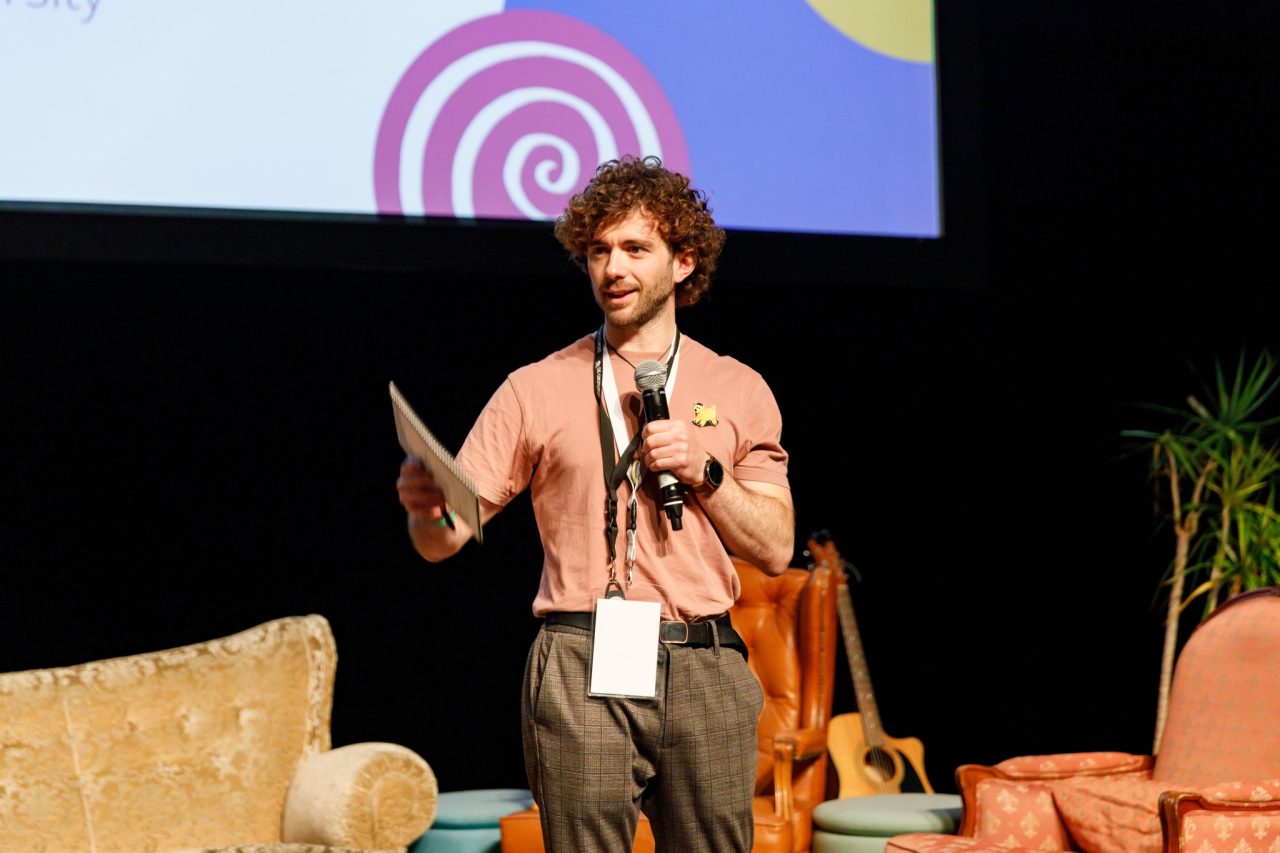
Brigita Medne at a SALTO PI co-creation event, 2025. Photo: Rene Riisalu.
When the team behind the EU Youth Participation Strategy reviewed recent data, something didn’t add up. Between 2021 and 2023 only 9,8% of participants in Erasmus+ Youth projects with participation themes were young people with fewer opportunities. This is considerably lower than the 30% of estimated participants in Erasmus+ Youth KA1 (Learning Mobility of Individuals) who are young people with fewer opportunities.
Brigita Medne, the former Coordinator at SALTO Participation & Information (SALTO PI) and Henrique Gonçalves from SALTO Inclusion & Diversity (SALTO ID) agree that this was a wake-up call. It signalled a deeper issue: participation in EU youth programmes still tends to serve young people who already have advantaged positions—and exclude those who face structural barriers.
Their joint work on the Youth Participation Strategy (more specifically, the Aim 6 chapter) focuses on strengthening the link between inclusion and democratic participation. Aim 6 examines what are the barriers for young people with fewer opportunities to be involved and what needs to change for participation to become genuinely accessible and inclusive.
Participation is a human right — but not everyone is heard
“Participation isn’t an activity or a method. It’s a right,” says Brigita. “And if it’s a right, then everyone should have the means, support and space to influence decisions.”
Yet, she argues, the youth field often assumes that non-formal education formats, such as colourful exercises, group discussions, interactive workshops, are automatically accessible. They are not.
Brigita and Henrique point to concrete examples. Young people with social anxiety may not feel safe speaking in groups. Others process information differently or face barriers linked to disability, mental health, trauma, discrimination, poverty, migration status or geographical isolation. Many simply do not recognise themselves in the standard formats we label as ‘participatory’, particularly when these are rigid, fast-paced or designed without accessibility in mind.
The research highlights that inaccessible environments and methodologies, unclear or overly complex information, digital divides and tokenistic consultation continue to shape who can participate meaningfully. These structural barriers disproportionately affect young people with fewer opportunities and often lead to feelings of exclusion, distrust of institutions and disengagement from democratic processes.
“When we don’t question the methodology and approaches we have been using, democratic participation is something only the already-included can access,” Brigita notes.
The monitoring report on the Youth Participation Strategy made the problem clear.
The paradox: participation projects can be exclusionary
Statistics from the RAY research showed that participation-themed projects involved less young people with fewer opportunities than other Erasmus+ initiatives.
Henrique describes a recurring pattern: youth with lived experience of barriers are often invited only to speak about those barriers.
“A young person with a disability talks about disability. A racialised young person talks about racism. That’s valuable, but it limits them. They care about the climate, digitalisation, and democracy – everything that young people care about. They should be shaping those conversations too,” he notes.
In short, inclusion cannot be separated from participation. “You cannot have meaningful participation if you only include people symbolically or within narrow roles,” he adds.
What the research is revealing
To explore this further, a desk review and a series of interviews supporting improvements to inclusive participation were conducted, and the findings already highlight several issues:
1. The youth field rarely questions its own methods
“Participation frameworks from the 1980s are still used, even though they have been widely criticised in research. In practice, trainers often rely on the same methods they have used for years, simply because there is little time, support or incentive to update their knowledge. As external service providers, they are rarely compensated for staying informed about new research or rethinking their methodology,” Brigita explains.
2. Intersectionality is missing
Henrique encouraged the research to look more closely at overlapping forms of discrimination, since young people who face several barriers at once often experience participation in very specific ways.
For example, being both racialised and disabled or navigating multiple social obstacles, shape whether and how a young person can participate. He suggested researchers strengthen this intersectional lens because, in practice, these layered experiences are a major part of what determines real access to participation.
3. Structural barriers still shape participation
Henrique and Brigita emphasise some of the aspects and barriers to consider.
- Participation without real influence
Young people are often consulted, but their input does not shape decisions or priorities. - Systems that exclude by default
Legal rules, age limits and formal decision-making structures are not designed with young people with fewer opportunities in mind. - One-size-fits-all formats
Rigid, formal participation methods do not match different needs, abilities or ways of expressing opinions. - Participation is costly
Lack of money, time, transport, stable work or nearby opportunities makes taking part harder or impossible. - Discrimination and stereotypes
Ageism, racism, ableism, gender norms and prejudice reduce trust, confidence and a sense of belonging. - Inaccessible and unsafe spaces
Many participation spaces ignore accessibility, sensory needs and safety, especially for disabled, migrant, racialised and LGBTQI+ youth. - Unclear information and digital gaps
Information is often hard to understand, poorly communicated or inaccessible online.
These are not side issues; they affect who can show up, speak, and stay safe.
A system designed for certainty — except for young people
One of the strongest critiques from both experts concerns how Erasmus+ and ESC applications are currently structured.
Institutions like SALTO can work flexibly with projects and activities. But beneficiaries, often volunteers or small NGOs, must submit, before funding:
- a complete programme,
- a described participatory process,
- fixed methods and outcomes,
- and sometimes evidence of youth involvement.
“It’s hypocritical,” says Brigita. “We don’t have to plan our activities two years ahead in full detail and we can adjust in the process based on what our target group says and needs. But we ask young people and grassroots groups to do exactly that.”
This is not just a technical issue. It reflects adultism, a belief system that treats adults as inherently more competent and trustworthy than young people. This belief is embedded in structures that question young people’s intentions and require them to prove themselves before being given support.
At the same time, this is not a critique of SALTO Resource Centres or National Agencies having easier access to funding. Mechanisms such as the Quality Label already exist to reduce administrative burden for beneficiaries.
However, more flexible and structural funding is still needed, including for grassroots organisations and young people. In addition, existing tools such as Erasmus+ and European Solidarity Corps inclusion support, which can cover additional costs linked to participation of young people with fewer opportunities, remain underused or insufficiently known.
How will inclusive participation be supported more?
The Youth Participation Strategy needs further active implementation. Aim 6 centres on connecting participation and inclusion in practice.The monitoring of the Strategy also recognised that plans to develop a toolkit and a checklist for inclusive youth participation may not be the activities needed at this point.
The current and next steps for SALTO PI and SALTO ID are not only related to identifying problems, but also about helping beneficiaries and National Agencies build the capacity to strengthen meaningful and inclusive participation.
-
A co-creation process with the field
Organisations, as a potential target group for the training, were invited in early 2026 to help shape the next capacity-building activities. This process is intentionally designed to be participatory, bringing together National Agencies, beneficiaries and other actors to share their perspectives and co-design the way forward.
Henrique emphasised that research alone cannot fill the existing gaps, and that developing solutions requires many voices, practical experience and a supportive environment for collective learning.
-
A series of webinars
Four thematic webinars make up a series that was launched in February 2026, with the final session scheduled for May, focusing on inclusive youth participation. Three sessions have already taken place. Each webinar explores, from an intersectional perspective, the specific obstacles faced by young people with fewer opportunities that limit their participation in democratic life, while also showcasing good practices and strategies to support their empowerment and engagement.
The webinars provide an overview of the barriers young people encounter in current democratic participation mechanisms and methodologies, share concrete examples and practical tools, and create space for participants to exchange experiences and reflect on how these approaches apply in their own contexts.
-
In-person training
Building on the webinar series, a training course in June 2026 will explore the obstacles faced by young people with fewer opportunities in democratic participation. It will also present good practices and strategies to foster inclusion. A space for Erasmus+ and European Solidarity Corps practitioners to:
– unlearn old assumptions,
– experiment with methods,
– and practise inclusive participation approaches.The topics will build on those covered in the webinars, while remaining open to exploring democratic participation of young people with fewer opportunities across different contexts.
-
Finalising the research
A review with interviews and survey data will map barriers, tools, gaps and examples. This will be communicated in bite-sized and digestible form useful for those who wish to dig deeper.
Modelling the change from within
The mission is to practice what is being advocated.
“For example, the second capacity-building activity already has a host, but no fixed format. We intentionally leave space for organisations to shape it, accepting uncertainty as part of genuine participation,” Brigita explains.
This work is not planned as a stand-alone yearly activity. Rather, it forms part of a longer-term approach, with ongoing webinars and in-person capacity-building activities foreseen in the coming years to provide continuous support to National Agencies and beneficiaries.
Henrique recalls coordinating an advisory group of people with lived experience while preparing a previous Inclusion & Diversity Forum. Over several months, this group met online to review the event’s content, methodology and accessibility, offering feedback and concrete ideas at each stage. Their suggestions helped reshape the programme, making it more inclusive, safer and more relevant to participants’ needs.
The experience also demonstrated what is often missing in regular practice: time, space and structured processes for meaningful input. He noted that many organisations across Europe are already experimenting with similar approaches and have developed tools and practices that work well, even if these examples still need deeper review in the ongoing research.
“I hope advisory and co-creation structures like this become the norm in National Agencies and other institutions, such as SALTO Resource Centres,” he says, noting the value they bring when young people with fewer opportunities help shape decisions from the very beginning and emphasising that such mechanisms are essential if inclusive participation is to become the rule rather than the exception.
What needs to change in Erasmus+ and ESC
What kind of change is needed? Both interviewees identify some, even though not an extensive list, of the potential shifts that would support inclusiveness in participation:
- More flexibility for beneficiaries
Participation processes must be allowed to evolve—not frozen before a project even begins.
- Funding participation properly
Young people should not be expected to contribute significant unpaid labour in project design, especially important to consider with young people with fewer opportunities.
- Bringing young people in at the start
Not just as participants or consultants, but as co-creators of the programmes in their core.
- Competence-building for decision-makers
Youth participation is not just about helping young people learn about their right to participate. They also need to be heard. So decision-makers also need to develop and update their skills and attitudes, especially how to listen and share power.
Ten years ahead: wish for the future
If Brigita and Henrique would have to choose one vision for the future, what would it be?
Henrique says he wants to see institutions routinely involving people with fewer opportunities in early-stage decision-making, not as tokens, but as equal contributors.
Brigita wishes programmes to genuinely implement the changes that youth-led and lived-experience organisations are calling for. And when something isn’t possible, she wants clear accountability.
Both agree that participation must move beyond symbolic gestures. It must become structurally supported, funded and expected.
The findings behind inclusive participation in the Erasmus+ and European Solidarity Corps are not only about young people—they are about the systems that shape their opportunities. Without inclusion, participation will continue to reproduce privilege, even in programmes designed to challenge it.
As Brigita puts it: “The question we must always ask is: who is affected by these decisions, who are we excluding and how to change that?”