











Young People’s Participation Rights & The Right to Participate
Year of production: 2026
Young people are not only future citizens; they are active members of society today. Their voices, experiences, and ideas are essential to democratic decision-making and to the development of communities that are fair, inclusive, and responsive to change. Supporting youth participation therefore means recognising young people as rights-holders and as valuable contributors to public life.
Youth participation is a fundamental right.
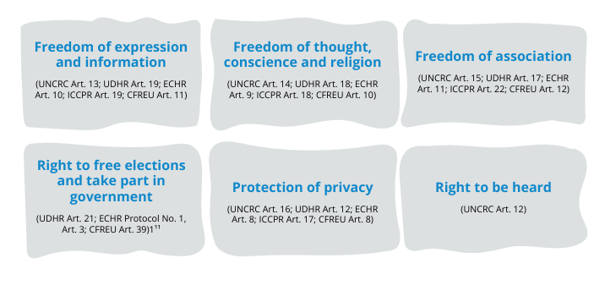
The right to be heard is enshrined in the UN Convention on the Rights of the Child and, more broadly, is a civil and political right derived from the Universal Declaration on Human Rights, the European Convention on Human Rights, and associated articles. States and state actors have a duty to promote and protect these rights.
The European Youth Programmes provide an important vehicle through which the youth sector can contribute to upholding this obligation. By supporting projects, initiatives, and learning opportunities across Europe, these programmes help create conditions in which young people can participate meaningfully in civic, political, and democratic processes.
Youth participation can take place in many different spaces
It is useful to consider how these spaces can either enable or limit young people’s involvement. Participation may happen in schools and educational institutions, for example through school councils, student representation, or other forms of organised dialogue. It may also take place in public spaces, such as town squares, streets, and community settings, through volunteering, campaigning, advocacy, and civic action.
Increasingly, youth participation also occurs in digital spaces, where young people engage in debate, activism, networking, and campaigning through online platforms and forums. In addition, participation can take place within formal political institutions, such as municipal councils, political parties, national bodies, or European policymaking processes, where young people may meet with decision-makers and contribute to policy discussions.
Youth organisations, civil society structures, and youth programmes are also important spaces for participation. Within these settings, young people may contribute to decisions about how organisations, activities, or programmes are designed, implemented, and evaluated. When these spaces are genuinely participatory, they allow young people not only to be present, but also to influence decisions and shape outcomes.
There are many different ways in which young people can participate in democratic life. These include:
- involvement in voting and elections;
- co-production and co-management;
- protest and advocacy;
- civic activism and volunteerism;
- digital youth participation;
- involvement in deliberative participation;
- membership of civil society organisations.
The European Youth Programmes are a vital tool for supporting youth participation across these different forms and spaces. Projects funded through these programmes can address participation as a topic, as a process, and as an outcome. This means that participation may be the main theme of a project, the method through which the project is carried out, or the result that the project aims to achieve.
The types of projects that can support young people’s participation in democratic life, and that may be funded through the European Youth Programmes, include:
- projects that involve young people in project design, implementation, and dissemination, and that are run on a genuinely participatory basis;
- projects that support young people in developing the competences required for democratic life;
- projects that enable young people to contribute actively to political and civic life as volunteers;
- projects that promote young people’s involvement in decision-making within the European Youth Programmes themselves;
- projects that support young people in having their voices heard within democratic decision-making processes.
Meaningful youth participation does not happen by chance. It requires intentional spaces, supportive structures, and a genuine commitment to sharing power with young people. By enabling young people to contribute to decisions that affect their lives and communities, the European Youth Programmes help strengthen democratic culture, civic engagement, and inclusive policymaking across Europe.
Youth participation is therefore both a fundamental right and an essential practice for strengthening democracy. By enabling young people to contribute to decisions that affect their lives and communities, the European Youth Programmes help promote democratic culture, civic engagement, and inclusive policymaking across Europe.
For more information, check out our Quality Standards for Meaningful Youth Participation in Democratic Life resource.